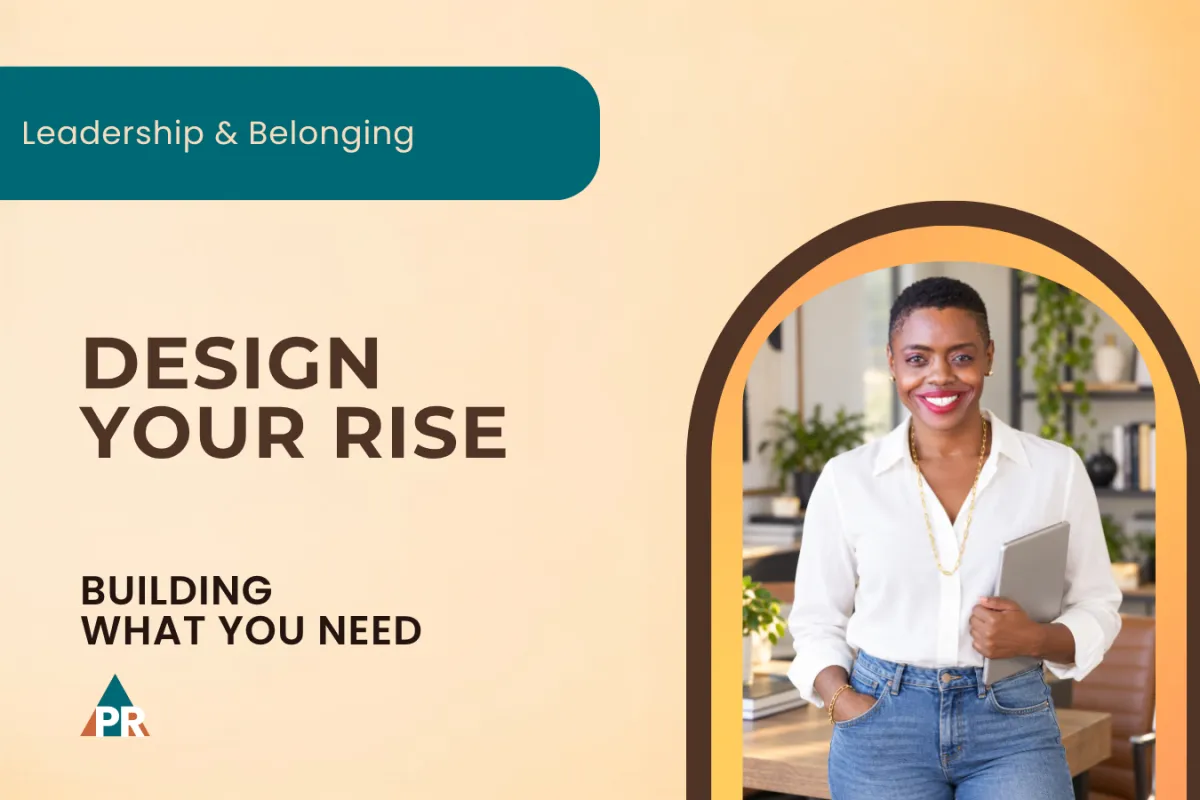
Why Black Women Must Design Our Own Professional Development Resources

There is a moment that lives in my memory from my early pharmaceutical career. I was an intern on a break from campus life, sitting in a district dinner meeting, and someone asked where we should take our physician clients for an elegant evening event.
"Red Lobster?" I offered, genuinely.
The look I received in return told me everything I needed to know about the distance between where I stood and where I needed to go. The answer, it turned out, was an elite country club in suburban Detroit. Not Red Lobster.
That moment represents something I would spend the next two decades learning to name: the gap between what we know and what we need to know is not just about information. It is about exposure. It is about who designed the map we are trying to follow. It is about whether the architects of our professional development have ever stood where we stand.
The Programs Were Good. They Were Also The Beginning Steps on a Longer Road.
I want to be clear about something from the start: I have deep respect for every coach, program, and framework I encountered on my journey. A program on personal branding helped me translate the marketing principles I studied in college and put into practice over 20 years on billion dollar brands into how to build that same strategy for individual leaders. A different program taught me funnel architecture. From there, I joined a community that showed me how to move from digital marketing theory to execution. A leader in the live events space created a program that revealed the granular details of event planning I never would have considered. I discovered programs that didn’t require me to separate my faith from my mission. I read books that deepened my understanding of human psychology, how we make decisions, and move from I’ve never heard of you, to saying yes. Another mentor introduced me to the world of brand partnerships and the power of the creator economy.
Every single program had value.
Every single experience was also shaped through the lens of who the developer had in mind when they built it.
What I discovered, program after program, was that I was collecting Lego pieces. Brilliant, well-designed Lego pieces. The challenge was that these pieces were designed for a different structure than the one I was trying to build. I had to take each piece, examine it, decide what was useful, set aside what created friction, and reconfigure everything to fit the reality I was navigating.

That reality included:
Working in a highly regulated industry where healthcare compliance was non-negotiable
Operating within Fortune 500 corporate politics that did not match the communal, relationship-first culture of my HBCU experience
Building visibility for Black leaders without triggering the defensive responses that often come when we name who is missing from decision-making tables
Straddling a corporate identity while building something independent and oriented toward legacy
The programs did not account for these realities. They could not. They were not designed with these specific problems in mind.
The Body Knows Before The Brain Can Name It

I remember calling my manager after my first national sales meeting on a team I had joined weeks before. The energy of that room felt like a complete mismatch to everything I had experienced under a different leadership structure, where we literally had a step show on stage at a product launch. Where Black culture was celebrated. Where I saw proof that it was possible to bring the fullness of who we are into corporate spaces.
This new environment felt different. The message was clear: hit your numbers or face elimination. The energy was aggressive in a way that felt misaligned with everything I valued.
"I think I made a mistake," I told my manager. "Is this the culture? If this is what success looks like here, I am going to be the wrong fit for you."
Looking back now, I recognize that my body was telling me something my brain had not yet fully processed. I was experiencing a values misalignment. An energetic mismatch. A cultural disconnection.
Professional development programs rarely teach us to honor that whisper. They offer great frameworks and processes to make evidence-based decisions. Business culture often favors speed and acceleration. They do not always show us how to pause when the energy feels wrong, to ask whether the model we are being handed was designed for bodies and experiences like ours.
We See Who Is Missing
Here is what I know about Black women that I wish more people understood: when we get a seat at the table, we do not just notice that we are the only ones. We notice everyone else who is missing, too.
We see the Latina sister who should be here. We see the Black man whose voice is absent. We see the person with a disability who was never considered. We notice the totality of who is not represented.
This is not a burden. This is a gift. This is the lens that makes us uniquely positioned to design professional development that lifts more than just ourselves.
When I began to consider what I wanted to create, it was never just about my own advancement. It was about creating pathways for Black leaders across the Fortune 500. It was about solving the visibility gap between senior decision-makers and the talented people I see every day. It was about building digital platforms that provide a 360-degree view of who we are: what we contribute within organizations and what we build in our communities.
Mainstream programs taught me to build a personal brand. What I needed was guidance on building a movement.
What Culturally Resonant Professional Development Looks Like
After years of adapting, reconfiguring, and translating mainstream frameworks, I can now name what was missing. What we need are professional development resources that:
Start with the cultural foundation first, then layer in technical skills. You cannot bolt belonging onto a framework that was designed without you in mind. The foundation has to be right. The energy has to align. Then you can add the execution strategies.
Account for regulated environments and compliance realities. Healthcare is not a move-fast-and-break-things industry. Public sector work is not a growth-hack ecosystem. We need frameworks that respect the pace and complexity of the sectors where many of us build our careers.
Honor the reality that we are building while we climb. Most of us are not full-time entrepreneurs with venture capital backing. We are designing the future while holding down roles that pay our living expenses. We need strategies that respect that dual reality.
Recognize that our success is collective, not just individual. When we rise, we bring people with us. Our professional development has to be designed around creating pathways for the people who come after us.
Center paid opportunities, not free labor disguised as exposure. Every development opportunity I ever had was paid. From my high school work study to my FAMU internships to the coaching programs I invested in. I never worked without compensation. I’ve placed tremendous personal financial resources behind earning the leadership lens and skills I hold today. That principle shapes everything I build now.
The Work Ahead

I spent years believing something was wrong with me because the mainstream frameworks didn't quite fit. I thought I was too slow, too formal, too concerned with values when I should have been focused on velocity.
What I know now is that the frameworks were always meant to be a starting point. They were built for a different set of conditions, a different cultural context, a different set of constraints.
The question is not whether Black women can succeed using mainstream professional development resources. Many of us do. We are resourceful. We adapt. We translate. We make it work.
The question is: what becomes possible when we stop spending our energy adapting and start building resources designed for us from the beginning?
What happens when the foundation is culturally right, and we can layer in technical skills without friction?
What happens when professional development is designed by people who see who is missing from the table and are committed to changing that reality?
This is not about rejecting what exists. This is about building what has been missing.
This is about Black women taking our seat in the driver's seat of our own development. Not as passengers trying to navigate someone else's map. As architects designing the pathways we need.
The Lego pieces I collected along the way were valuable. Every single one taught me something.
What I am building now is the internal navigation compass that should have come with them. The one that shows how to reconfigure these pieces for the structures we want to build. The one designed for women who are making their way unchartered waters, corporate spaces, regulated industries, and community commitments all at once. The one that honors the fact that when we rise, we bring others with us.
Because that is what Black women do. We see who is missing. We build the bridges. We create the pathways.
It is time our professional development resources reflect the unique challenges we face as we rise to executive tables.
📚
The Building Blocks: A Founder's Journey
Curious about the specific programs and books that shaped this journey? View the complete resource list here — from Rafat’s university studies to the coaching programs, frameworks, and books that informed how we think about building human-centered systems today.