Digital Real Estate: How to Build a Career Portfolio You Own

Here's a question worth thinking about: if your role ended tomorrow—not because of anything you did, but because the industry pivoted, the organization restructured, or the funding shifted—what would still be standing? What space, still yours, would speak to the body of work you've spent years building?
For most of us, the honest answer is: not much. And that's not a personal failing. It's the predictable outcome of building a career the way most of us were taught: keep your head down, work hard, and trust that the reputation you earn inside company walls will carry your story forward.
I wish someone had reframed this for me early on—not as a nice-to-have, but as something to construct deliberately, the way you would build a retirement account or fund an emergency cushion. Slowly. Steadily. Over years.
Because that's what digital real estate really is: career insurance. The kind no one handed us the policy for.
The work may be yours. The visibility often isn't.
Look inside almost any organization and you'll find the same quiet pattern: talented people execute the work while the results and recognition point back to the company brand. You lead initiatives, untangle the human problems no one else is positioned to see, and contribute to outcomes that eventually become “the team delivered” or “the company achieved.”
Your contribution is real. But your name can disappear into the collective achievement—along with the visible record of how your expertise shaped the outcome.
That model might be enough if there were seats at the top for every qualified person who had earned one. There aren't. The higher you climb, the narrower the field becomes relative to the number of capable leaders competing for the opportunity. At that altitude, differentiation is no longer optional. It becomes the linchpin.

Disruption exposes the gap
Then there is the scenario none of us wants to plan for: an industry contracts. A role is eliminated. A company is acquired, restructured, or simply stops needing what you offer.
When that moment arrives—and at some point in most careers, it does—you need to be able to point to how your perspective adds value to the mission. If that record exists only inside a company's internal systems, you are rebuilding your story at exactly the moment you can least afford to start from scratch.
Digital real estate is more than a website
Digital real estate is the connected ecosystem tied to your name, your perspective, and your body of work. It travels with you through promotions, role changes, industry pivots, and disruptions you never anticipated.
A website can serve as the anchor, but the ecosystem is bigger than an address. It is the system that helps people understand what you know, discover what you have created, continue a conversation with you, and stay connected over time.
Social media still matters. It can introduce your ideas to people who do not know you yet. But it is borrowed distribution: the platform decides how much of your audience sees what you publish. The goal is not to abandon social media. It is to use those spaces as doorways that invite people back to a home base where you can shape the experience.

The seven Platform Ingredients
A durable digital ecosystem gives your leadership:
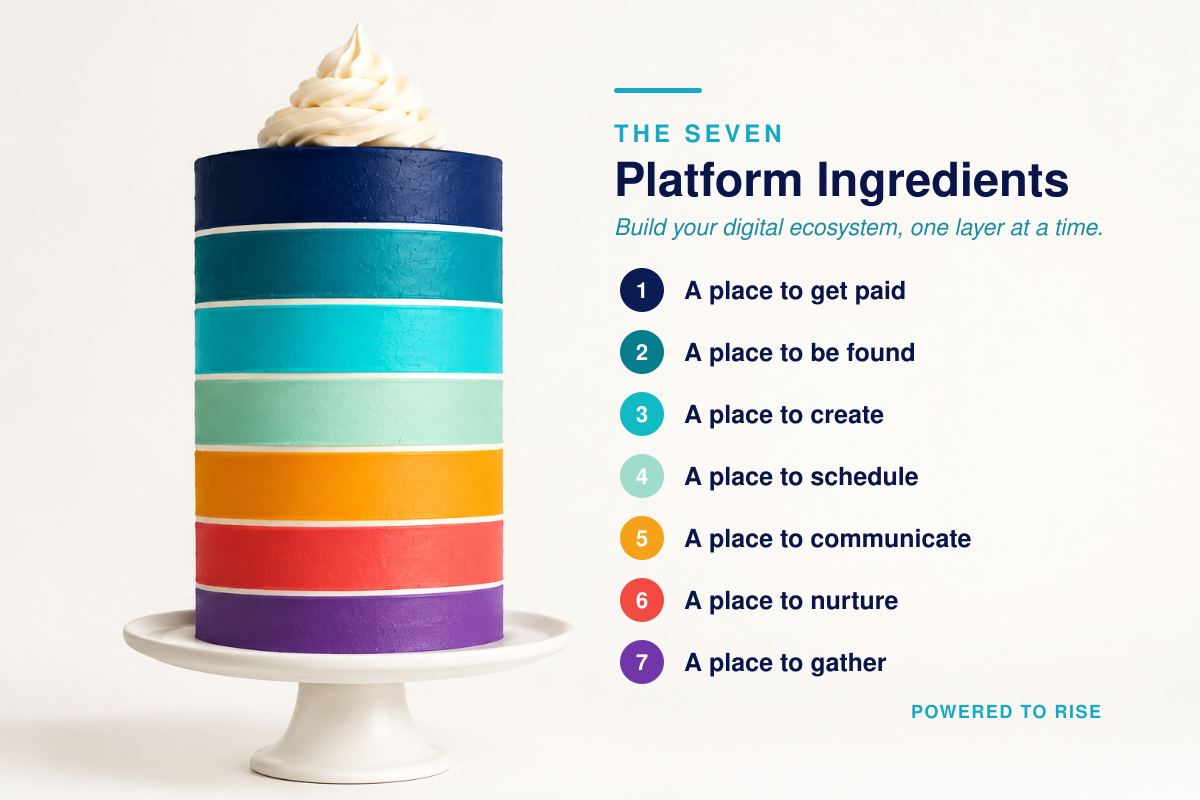
The goal is to allow strategic software investment to bring your expertise closer to the people, problems, and opportunities it is equipped to serve.
Why this works as career insurance
This way of thinking was counterintuitive for someone like me, raised by Baby Boomer leadership norms. We were taught that career-building meant demonstrating loyalty inside the company: do exceptional work, rely on the system, and trust that performance cycles would carry your story into the rooms where opportunities were discussed.
Visibility outside those walls could feel almost disloyal—like a signal that you did not believe the institution would take care of you. But that system was never architected to hold the full arc of a human being's professional story.
When you build your digital real estate with intention, your expertise becomes easier to understand. You stop appearing interchangeable within a broader company brand. When you interview, pursue a promotion, explore consulting, or position yourself for a new opportunity, you are not reconstructing your case from memory. You can point to a body of work you have been building all along.
That visibility can support the organizations you serve, too. A leader with a credible public body of work can extend the reach of good ideas, strengthen trust, attract aligned collaborators, and bring more context into the rooms where the work happens.

Build one layer at a time
You do not need to build the entire ecosystem this week. In fact, you should not.
Start with the ingredient that best supports where you are today, then add the next layer as your leadership, audience, and goals evolve. The strongest system is not the one with the most tools. It is the one you can actually use, maintain, and grow.
Start here:
Search your own name.
Open your most visible professional profile and read it like a stranger would—a recruiter, a future client, or someone who has never met you.
Ask: What would this person assume I know how to do?
Compare that assumption with what you know to be true.
Choose one asset that begins closing the gap.
That next asset might be a clearer LinkedIn headline, a personal domain, a one-page website, a place to publish your thinking, or a simple system for staying connected to the people you meet. You are not starting from zero. You are making visible what has already been true.
Your value is greater than any singular lens the world may be viewing you through today. Build a system spacious enough to carry more of the story.
Ready to build the system behind your talent?
Watch The Platform Ingredients, the complete nine-part video series, and choose the layer that makes the most sense for your next chapter.
If you would like help turning that layer into a practical plan, schedule a free 30-minute call and let’s talk through what fits your goals.


