
Organizations Need Our Experience to Win With AI
We know our businesses, our communities, and the problems worth solving. That knowledge deserves investment, technical support, and opportunities to lead.
🎧 Listen to this article
AI-generated voice - ElevenLabs v4 model
You can be the person everyone calls when the work needs to get done and still be missing from the meeting where priorities are set and budgets are approved. For Black professionals, the expansion of AI brings that distance between contribution and authority into sharper focus.
I wrote this series to help us understand the change taking place around us and consider where our experience belongs in it.
In Part 1, we followed AI beyond the chat window and into the work itself.
In Part 2, we looked at the decades of research, investment, and human effort behind today’s capabilities.
That history brings us to the question I believe is my life’s work: Who gets the investment and opportunity to navigate our communities to better outcomes?
Black professionals already contribute to AI. Our presence, however, has not secured equal access to the positions that direct technology and its rewards. This final installment examines that gap and proposes a way forward: help our community develop skills now, while building partnerships that connect those skills to paid work and careers with growing responsibility.

Are we buying the tools, delivering the work, or directing the investment?
Each role has value. The difference is the authority to fund an idea, define a role, or approve a system.
We are here. Who gets to build the blueprint?
Our participation spans research, entrepreneurship, advocacy, and everyday use. Black in AI, co-founded by Timnit Gebru and Rediet Abebe, works to expand Black participation in AI development, deployment, and regulation. In a survey published in June 2026, Pew Research Center found that 49% of Black adults reported using AI chatbots, compared with 49% of Hispanic adults and 46% of White adults.
Those adoption numbers establish that people are using the tools. A different body of evidence shows how unevenly technical careers and authority have been distributed. The EEOC’s analysis of 2022 workforce data found that Black workers represented 11.6% of the overall U.S. workforce, but 7.4% of high-tech workers and just 5.7% of high-tech managers. Our share was smaller again at the management level. See pp. 4 and 16 of the archived report and the EEOC’s original announcement.
These figures describe the broader technology workforce, rather than today’s AI leadership. They give us a reason to scrutinize the opportunities organizations create as they invest in AI: who enters the field, who advances, and who eventually directs design, hiring, and resource allocation.
The distinction is critical because the people making those decisions help determine which problems receive attention and whose experience informs a solution.
What our experience helps us see
Joy Buolamwini and Gebru’s Gender Shades research shows the stakes of evaluating technology across different populations. They examined commercial gender-classification systems and found substantial disparities across skin tone and gender groups, with darker-skinned women experiencing the highest error rates.
I encounter a different problem in my own work with AI-generated imagery. It has made the value of community knowledge tangible to me: I can recognize when an image misses the people I intend it to reflect.

I spend a lot of time creating images that reflect communities of color: dark skin, medium shades, and the variations in between. I want slimmer and more curvaceous bodies represented, too—the range of people I recognize in our communities.
Getting there often takes more prompts and corrections than creating lighter-skinned subjects. Each additional attempt uses time and, when a tool meters generation, tokens, credits, or part of a subscription allowance. The result I consider usable may cost more to produce than the first output suggests.
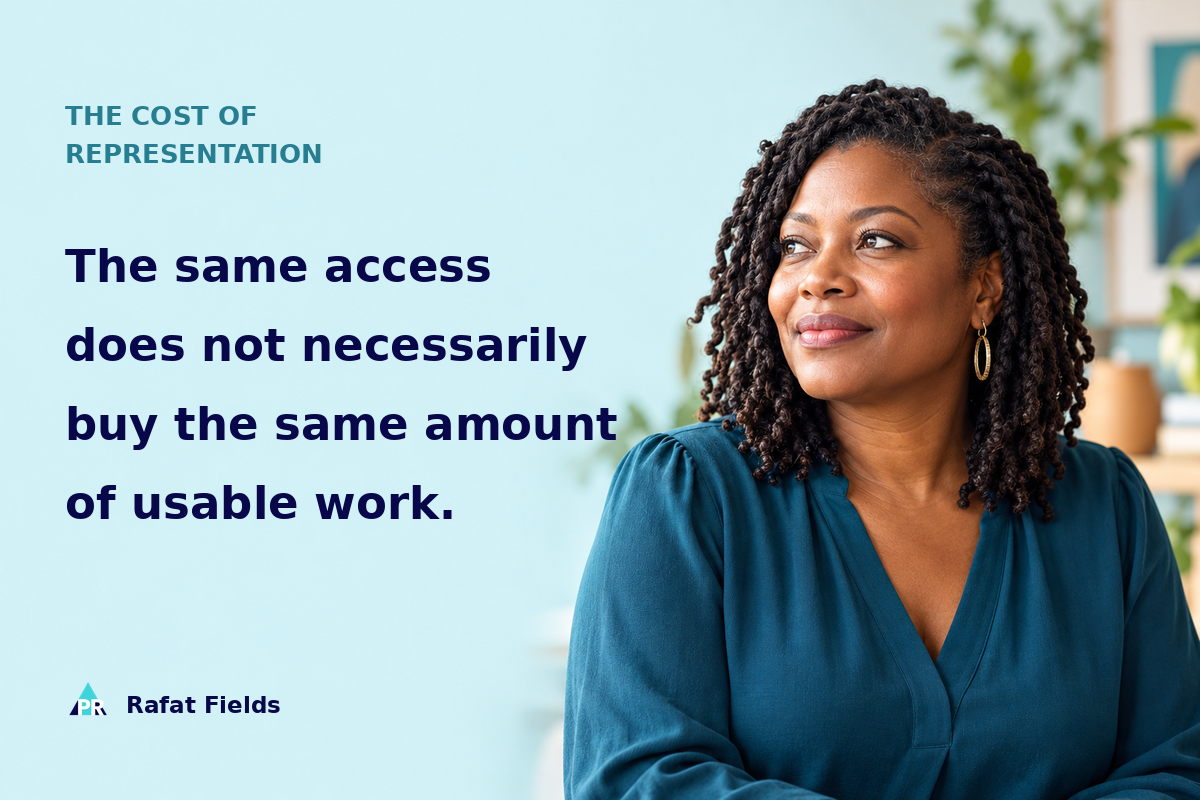
I absorb that cost because quality representation matters to me. My experience raises an equity question worth testing: do some users have to spend more to get results that reflect their communities? Product teams could compare the attempts needed across skin tones and body types, using quality standards informed by those communities.
This is also part of the business case for investing in Black expertise. Someone who recognizes a failure can help a team frame better requirements, choose meaningful tests, and evaluate whether the result serves its intended users. My experience is one example of knowledge that deserves a route into product decisions.
That route requires more than an invitation to use a tool. It requires opportunities to help define the work and influence what an organization accepts as success.
Black talent deserves a voice in the decisions that affect our work and communities.

The question the data cannot answer
Access to influential work is also why I pay attention to research about gender. LinkedIn’s August 2026 report, The AI Talent Divide, found that women accounted for 26% of U.S. hires into the AI occupations it studied in 2025, compared with 50% of non-AI hires. Its authors describe the divide as “access to the highest-value parts of the AI economy” (pp. 4, 6).
I appreciate this research. I was also disappointed to find no analysis of race or ethnicity, or explanation for that omission. Where are Black women in these numbers?
As a Black woman, I worry that barriers tied to race and gender may compound, leaving us with an even steeper climb. That is my concern; this report does not provide the racial breakdown needed to assess it. Averages for women overall cannot offer a clear vantage point to evaluate how Black women are faring within the broader population.
The report also found women concentrated in data annotation, among the lowest-paid AI roles. That is a gender finding, not a racial one. It illustrates why a workforce pathway needs to consider the kind of work people enter and their prospects for advancement, alongside the number of people hired.
For our community, keeping those questions visible takes a deliberate focus on Black outcomes.
Keep Black progress in view
Communities focused on Black progress help people share expertise, name barriers, and press for resources that address them. We can support one another across race, gender, and generations while still asking whether investment improves Black outcomes. Without that specific lens, a broad commitment to inclusion can leave our needs unexamined.
These communities are also places where learning can become collaboration: professionals meet technologists, founders meet potential partners, and employers can learn what people are already building.

This work is already happening:
AfroTech connects Black professionals through technology coverage, a professional network, and conference programming spanning AI, engineering, entrepreneurship, and work.
Technologists of Color builds community among Black technology professionals in Atlanta, sharing knowledge, resources, and opportunities. Its Coding While Black sessions create space to learn and collaborate.
Black Tech Week brings together talent, founders, and investors through community events, a career fair, and venture-capital office hours. In Los Angeles, Black LA Tech Week brings local organizations together for workshops, demos, and networking that amplify Black leadership.
These are just a few examples. Many more events, meetups, and technologist communities exist across the country. Search for what's happening nearby and in geographies you have an interest in. Bring a question, share what you know, and meet people whose skills complement yours. Those relationships can support learning before an employer creates a formal opportunity—and help employers find partners when they do.
Waiting has a cost of its own
I want our community to build skills before a job description or training invitation gives us permission. My concern is both what an employer might offer and when that opportunity might arrive.
A workplace may introduce AI through generating content or delivering work with an existing tool. Those skills have value. We should also seek exposure to designing workflows, building agentic applications, testing systems, and the engineering decisions behind them.
Timing matters, too. If our opportunities arrive in later waves, we may be learning a new generation of tools while others have already accumulated project experience and responsibility. That is a risk I want us to address now, rather than accept as inevitable.
Begin with a familiar problem: client follow-up, an operations handoff, or helping neighbors find resources. Build a small solution using information you're permitted to use. Compare it with today's process, noting what improved, what failed, and where human judgment mattered.

As you learn, look beneath the output. What steps does the workflow need? What information should the system use? Which decisions require a person? A technologist or community learning group can help you explore those questions and build the technical skills your project requires.
Document the choices you make. You will have something concrete to show a collaborator, client, or employer: how you understood a problem, tested an approach, and improved it. That is a starting point for experience that can grow into more consequential work.
Employers can invest in the next step
Independent initiative needs somewhere to go. Employers can create that next step by pairing their business needs with paid opportunities for people to apply and deepen their skills.
Several programs offer useful models. Their value to this discussion is the connection they make between recognizing capability, preparing people for work, and giving them a chance to demonstrate it.
OneTen launched in 2020 with a goal of helping one million Black Americans move into family-sustaining careers over a decade. Now called SkillsRight, it helps employers put skills-first hiring and advancement into practice.
Per Scholas’ Salesforce AI Fellowship, announced in September 2026, connects selected Salesforce training graduates with New York City nonprofits for eight months of paid work, supported by coaching and mentorship.
NPower’s registered technology apprenticeships also connect instruction with paid workplace training and mentoring.
These models serve different populations and locations; they are not all AI-specific or exclusively for Black talent. They offer approaches employers can learn from. A pathway intended to improve Black leadership representation must also ask what responsibility comes after the first assignment—and how participants can qualify for it.
Build a pathway around a real business need
An employer can put those ideas together around work it already needs to accomplish. Imagine a healthcare company partnering with a historically Black college or university, a community college, and a workforce nonprofit to sponsor an AI hackathon or guided build-along.
The company brings a defined challenge, such as improving an internal resource-search process. Employees mentor teams using synthetic or approved data. Participants contribute expertise in healthcare, operations, communication, or technology, with technical support available as they develop a solution.

The event introduces people to the work and to one another. The company then funds contract or project-based assignments with several entry points: documentation, testing, workflow mapping, system configuration, AI evaluation, or delivery coordination. Mentors help participants build from demonstrated skills into greater responsibility.
An experienced operations leader may be new to system configuration while already skilled at coordinating a complex project. A useful pathway recognizes both, then offers chances to take on design decisions, technical learning, and delivery leadership as capability grows.
This is the model I’m proposing employers build around their own business needs. Assignments need fair compensation, defined scope, supervision, and clear agreements about credit and ownership. Participants should leave with income, credible evidence of their contribution, and an understanding of what they can work toward next.
For employers, the opportunity is to solve a business problem while developing people who can carry that work forward. For participants, the first project should open a path to better pay and greater authority.
Start with the team already in the room
The same approach can begin inside an organization, with a team meeting already on the calendar. Bring a case colleagues recognize: a difficult handoff, a recurring reporting task, or a resource-search problem.
Hire a technologist or a small team of technologists to serve as team captains. They can guide colleagues through framing requirements and “vibe coding”—using plain-language prompts to generate, test, and refine an app prototype.
While the prototype takes shape, colleagues learn to turn business knowledge into requirements and test results together. Someone new to building apps may know exactly what users need; another may discover a strength in testing or workflow design.

Hiring Black technologists as guides creates paid work and brings community expertise into the business. Colleagues gain exposure to building a solution, with someone in the room who can help them understand choices and work through difficulties.
After the session, ask what people can now explain, evaluate, or try on their own. Use what you learn to identify further training and assignments with increasing responsibility. That follow-through is how a team-building activity can contribute to a development pathway.
Invest in the people who will carry the work forward
This series began with changes in what AI can do, then traced the long investment that made those capabilities possible. I wanted to end with the people whose knowledge can make that investment useful—and the opportunities they need to lead.
For our community, that means beginning the learning now and seeking experience beyond the first uses an employer may offer. For organizations, it means funding work, providing technical support, and creating routes from an initial assignment into design, engineering, and leadership.
The outcomes reach beyond a career title. The people who can direct resources have a chance to bring overlooked problems into view, choose whose needs a system serves, and hold the work accountable to those communities.
Black professionals are already building meaningful work. Organizations have an opportunity to develop more of that expertise into deeper business impact and better community outcomes.
Sources that informed this article
Explore the research behind this article, examples of paid workforce pathways, and Black technology communities creating opportunities to connect and grow.
Get a copy of the Sources & Further Reading guide for linked citations, reading notes, and the earlier articles in this series.
How I made this
AI technology that supported this article: Planning and writing: ChatGPT Sol 6.1 · Image generation: GPT Work · Assembly: ChatGPT Work and Notion AI · Editing and publishing: Sonnet 5.5 and HighLevel · Audio: ElevenLabs
Sign up for The Human Advantage for thoughtful insights on leadership, work, and the human side of technology.